JRC ECHOSOUNDER JFE-680
JRC
Refurbished
Manufacturer: Japan Radio Co., Ltd. (JRC)
Country of Origin: Japan
Model: JFE-680
Product Type: Navigation Echo Sounder / Marine Depth Sounding Equipment
Frequencies: 200 kHz standard; 50 kHz and dual-frequency configurations available
Display: 10.4-inch color display
Marine Application: Under-keel depth monitoring, seabed profile display, shallow-water navigation, docking operations and vessel navigation safety.
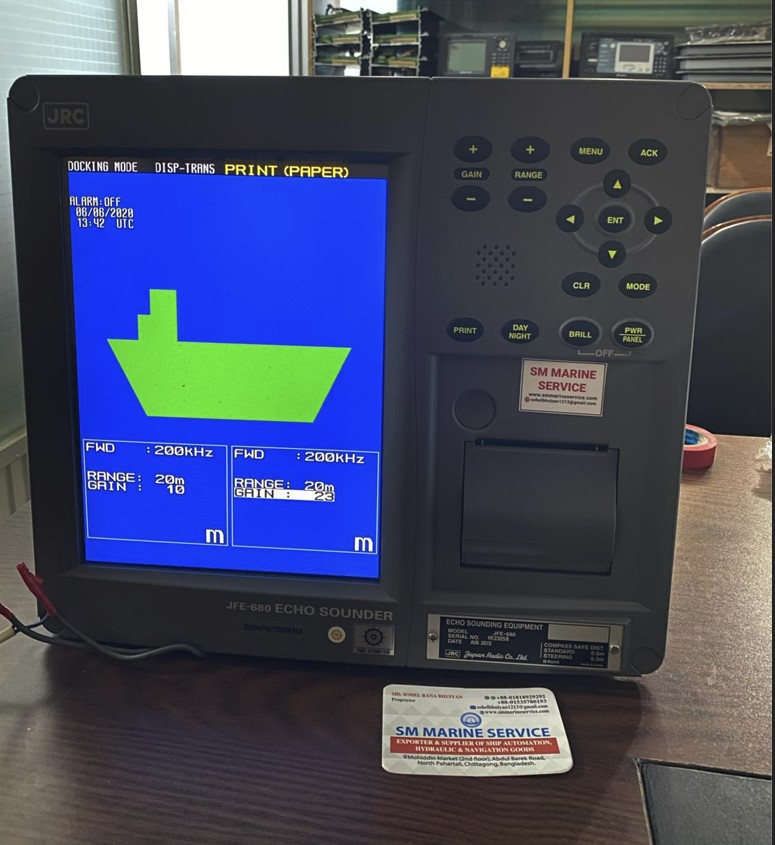
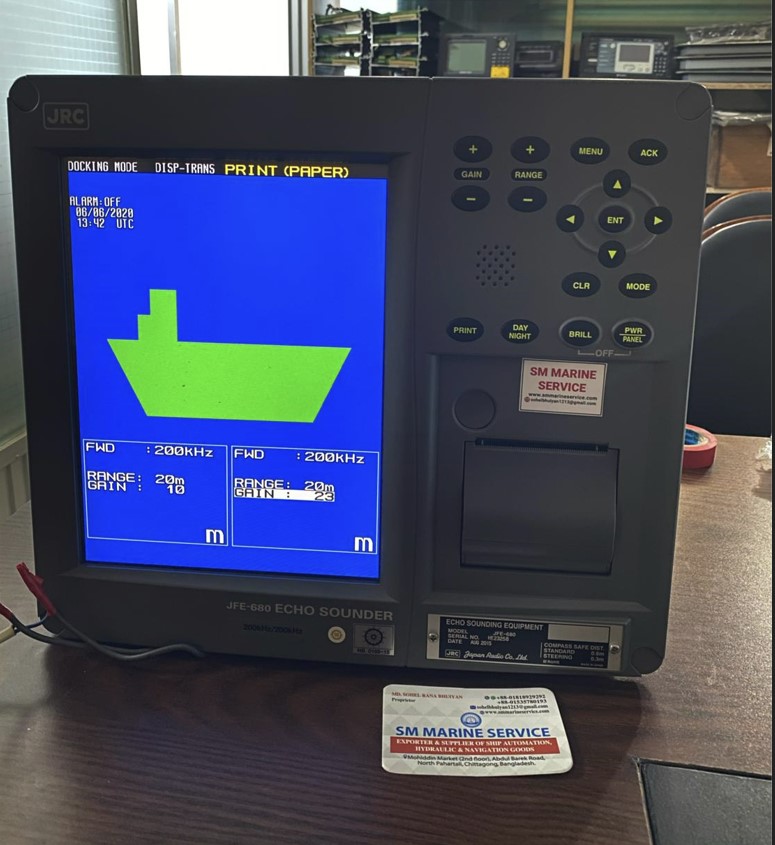
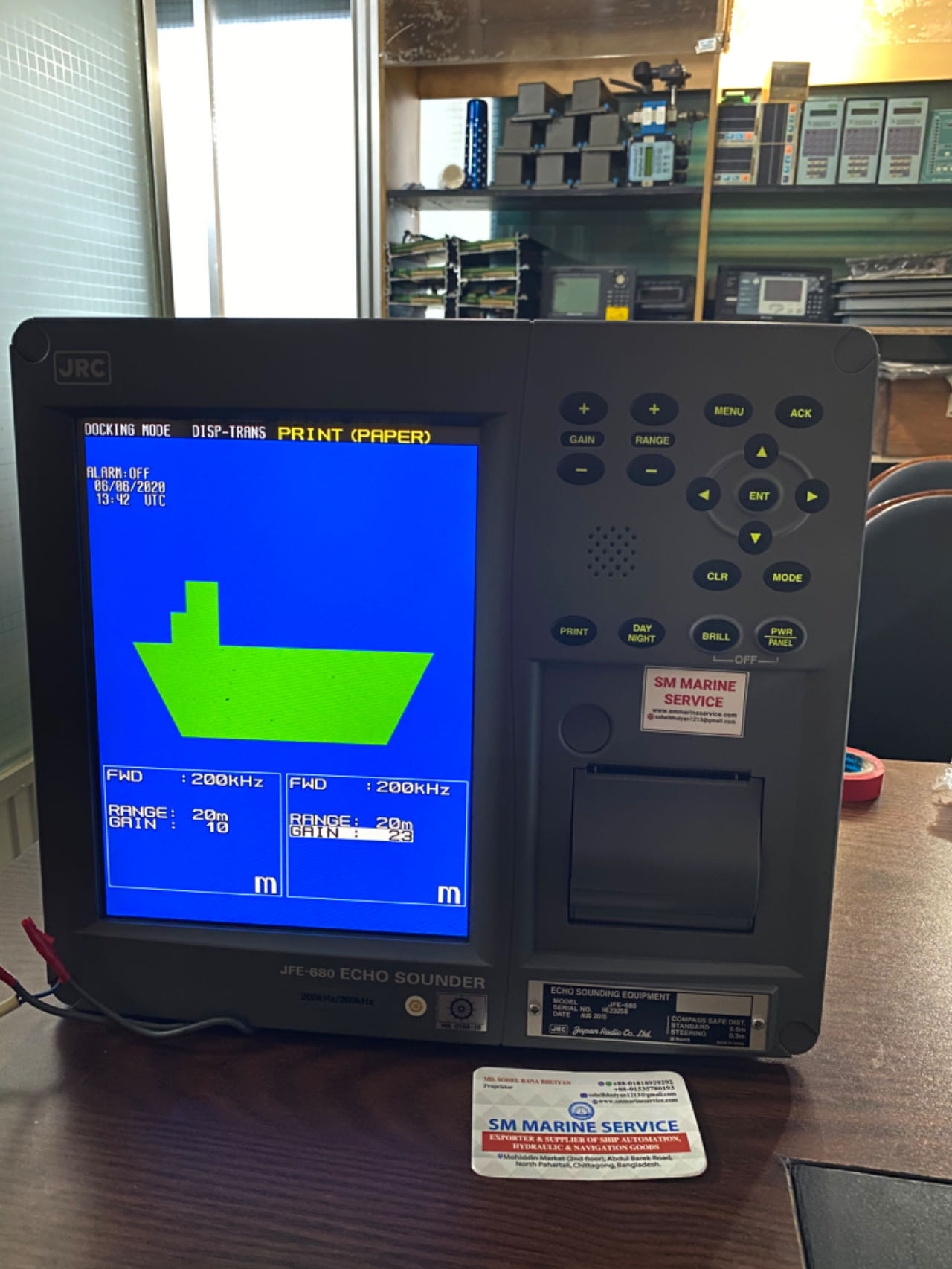
The supplied photograph clearly shows a working JRC JFE-680 Echo Sounder, with the display operating in Docking Mode and showing 200 kHz forward sounding information.

The JRC JFE-680 is a commercial marine navigation echo sounder manufactured by Japan Radio Co., Ltd. It measures the water depth beneath a vessel by transmitting ultrasonic pulses through a hull-mounted transducer and measuring the reflected signal from the seabed.
JRC designed the JFE-680 in accordance with IMO performance requirements for navigation echo-sounding equipment. In addition to real-time seabed and digital depth information, the system provides depth alarms, power-failure alarms and depth-data output.
One of its most useful characteristics is its support for Standard, History and Docking display modes, together with storage of depth information for up to 24 hours.
The JFE-680 determines water depth using the pulse-echo principle.
The transducer installed in the ship's hull sends an ultrasonic pulse downward. When this pulse reaches the seabed, part of the energy is reflected toward the vessel. The transducer receives the returning echo, and the JFE-680 calculates depth from the elapsed travel time.
The resulting information is displayed both numerically and graphically, giving bridge personnel an immediate indication of under-keel depth and seabed profile.
Depending on configuration, the JFE-680 can use one or two transducers and operate at 50 kHz and/or 200 kHz. It can therefore be configured for dual-frequency operation or separate bow/stern depth measurements.
The JFE-680 combines the major echo-sounding functions in a single bridge-mounted unit:
JRC documentation also describes eight-color or eight-level monochrome echo presentation and the ability to retrieve memorized sounding data through History Mode.
Standard Mode presents real-time sounding echoes and normal depth information.
History Mode allows previously stored depth data to be reviewed. JRC documentation specifies storage of approximately 24 hours of sounding information.
Docking Mode is particularly useful during low-speed maneuvering and harbor operations. Depending on the vessel's transducer arrangement, forward and aft sounding information can be presented for improved awareness.
The uploaded photograph is an excellent example—the display shows DOCKING MODE, with separate FWD 200 kHz indications.
The main unit integrates the LCD, operator controls, signal-processing electronics, connection section and printer.
The operator has direct controls for GAIN, RANGE, MENU, ACK, MODE, PRINT, DAY/NIGHT and BRILLIANCE, allowing important sounding parameters to be adjusted without navigating through complicated menus.
A built-in printer allows sounding information to be recorded as a physical printout for the ship's navigation records when required.
This integrated design eliminates the need for a separate external depth printer in many installations.
JRC documentation identifies the NKF-341 as the standard 200 kHz transducer.
For applicable 50 kHz installations, the NKF-345 transducer can be used.
The AW-154F is associated with the 200 kHz transducer configuration.
The AW-154F-50 is used for the corresponding 50 kHz arrangement. JRC's product literature identifies both matching-box variants.


The JRC JFE-680 is intended primarily for commercial vessel navigation and depth monitoring.
It can be used aboard cargo ships, tankers, container vessels, bulk carriers, offshore vessels and other ships requiring approved navigation echo-sounding equipment.
Typical applications include monitoring depth beneath the keel, approaching shallow waters, harbor maneuvering, docking, passage through restricted waterways and maintaining a historical record of sounding information.
A dual-transducer arrangement can be particularly useful on larger vessels where separate forward and aft depth information improves awareness during harbor and docking operations.
If the display is operating but no reliable bottom depth appears, check:
Transducer → cable → matching box → JFE-680 connections → Gain/Range settings.
Marine growth or bubbles beneath the transducer can also prevent reliable bottom detection.
Air bubbles passing beneath the hull can block or weaken ultrasonic transmission.
This commonly occurs during maneuvering, heavy seas, astern movement or when the transducer is poorly positioned relative to hull-generated turbulence.
If depth disappears temporarily and returns as vessel conditions change, bubble interference should be considered before replacing electronics.
Possible causes include low gain, inappropriate range selection, transducer degradation, cable problems, matching-box faults or difficult seabed conditions.
Gain should be adjusted so that the actual bottom is clearly distinguishable without excessive background noise.
Check the vessel's draft-related settings and confirm whether the displayed depth reference corresponds to the vessel's required operating configuration.
Also verify that the correct transducer/frequency channel has been selected.
On dual-frequency installations, if 200 kHz works but 50 kHz does not—or vice versa—the main display itself may not necessarily be faulty.
Check the affected channel's:
On dual-transducer systems, loss of Depth 2 should lead technicians to check the secondary transducer channel, cabling, matching box, gain settings and possible bubble interference.
Check printer paper installation first.
Also inspect the thermal printer mechanism, paper sensor, printer power and related connection. Thermal paper must be installed with the correct printable surface orientation.
The JFE-680 provides a power-failure alarm function.
Check the vessel supply, breaker, fuse, wiring, terminal connections and internal power supply before replacing the complete display.
A working LCD does not prove that the transmitter/receiver section is operating.
Technicians should separately evaluate the transducer, matching box and transmitting/receiving circuits.
Routine maintenance can significantly improve the reliability of an older JFE-680 installation.
Periodically inspect the transducer cable, matching box terminals, connectors, vessel grounding and power connections. Look for corrosion, loose terminals, moisture and mechanical cable damage.
The hull-mounted transducer should be inspected during dry docking. Excessive marine growth or coating over the active transducer surface can reduce acoustic performance.
Keep the cooling openings of the main display clear and avoid allowing excessive dust to accumulate around the thermal printer.
Printer paper should be kept dry and replaced with suitable thermal paper.
Use the system's diagnostic and alarm functions when investigating faults rather than immediately replacing expensive components. The JFE-680 documentation includes self-diagnostic capabilities intended to assist maintenance.
The JFE-680 remains installed aboard many commercial vessels because it is a robust, dedicated navigation echo sounder with straightforward controls and an integrated printer.
Its 50/200 kHz capability, dual-transducer configurations, 24-hour history, docking display and serviceable modular components make it practical to maintain on existing ships.
For an operational vessel with an established JFE-680 installation, replacing a defective display, transducer or matching box can also avoid unnecessary modification of existing bridge wiring and hull-mounted transducer arrangements.
This makes tested used, refurbished and reconditioned JFE-680 components relevant to ship owners and technical managers maintaining legacy JRC navigation systems.
The JFE-680 is a marine navigation echo sounder manufactured by Japan Radio Co., Ltd. It displays seabed echoes and digital water-depth information and conforms to IMO echo-sounder performance standards documented by JRC.
A standard configuration uses 200 kHz, while 50 kHz and dual-frequency configurations are also supported.
JRC documentation lists the NKF-341 as the standard 200 kHz transducer.
The NKF-345 is listed for the 50 kHz configuration.
Yes. It incorporates a thermal printer into the main unit.
Yes. Depth information for approximately the previous 24 hours can be stored and reviewed in History Mode.
Depending on configuration, the system can operate with two transducers and provide separate bow/stern depth information.
Standard, History and Docking.
Typical causes include transducer failure, cable or matching-box problems, excessive bubbles, inappropriate Gain/Range settings, weak seabed echoes or TX/RX circuit faults.
The JRC JFE-680 Echo Sounder is a professional marine navigation depth-sounding system manufactured by Japan Radio Co., Ltd., Japan. It features a 10.4-inch color display, integrated thermal printer, Standard/History/Docking modes, 24-hour depth history and optional 50/200 kHz dual-frequency or dual-transducer operation. Common system components include the NKF-341 200 kHz transducer, NKF-345 50 kHz transducer, AW-154F and AW-154F-50 matching boxes.
0
BDT 0
BDT 0
BDT 0
BDT 0
Marine Equipment Supplier