Voyage Data Recorder (SVDR)
FURUNO
Refurbished
Manufacturer: FURUNO Electric Co., Ltd.
Country of Origin: Japan
Equipment Type: Data Recording Unit (DRU) / Protective Storage Capsule
Model: VR-5020
Variants: VR-5020-6G / VR-5020-9G
Associated Systems: FURUNO VR-3000, VR-3000S and VR-5000 series
Marine Application: Voyage Data Recorder (VDR) and Simplified Voyage Data Recorder (S-VDR)
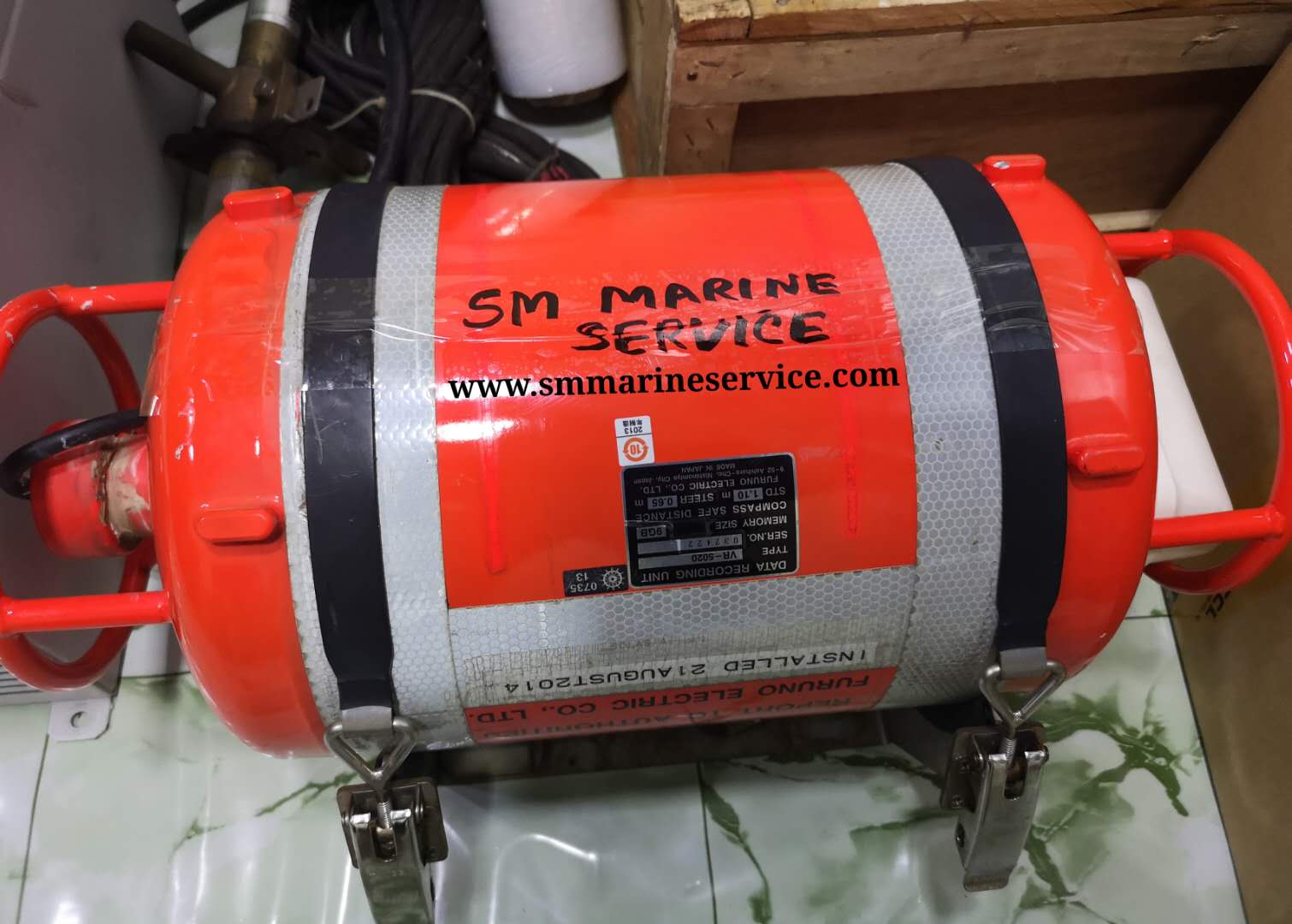
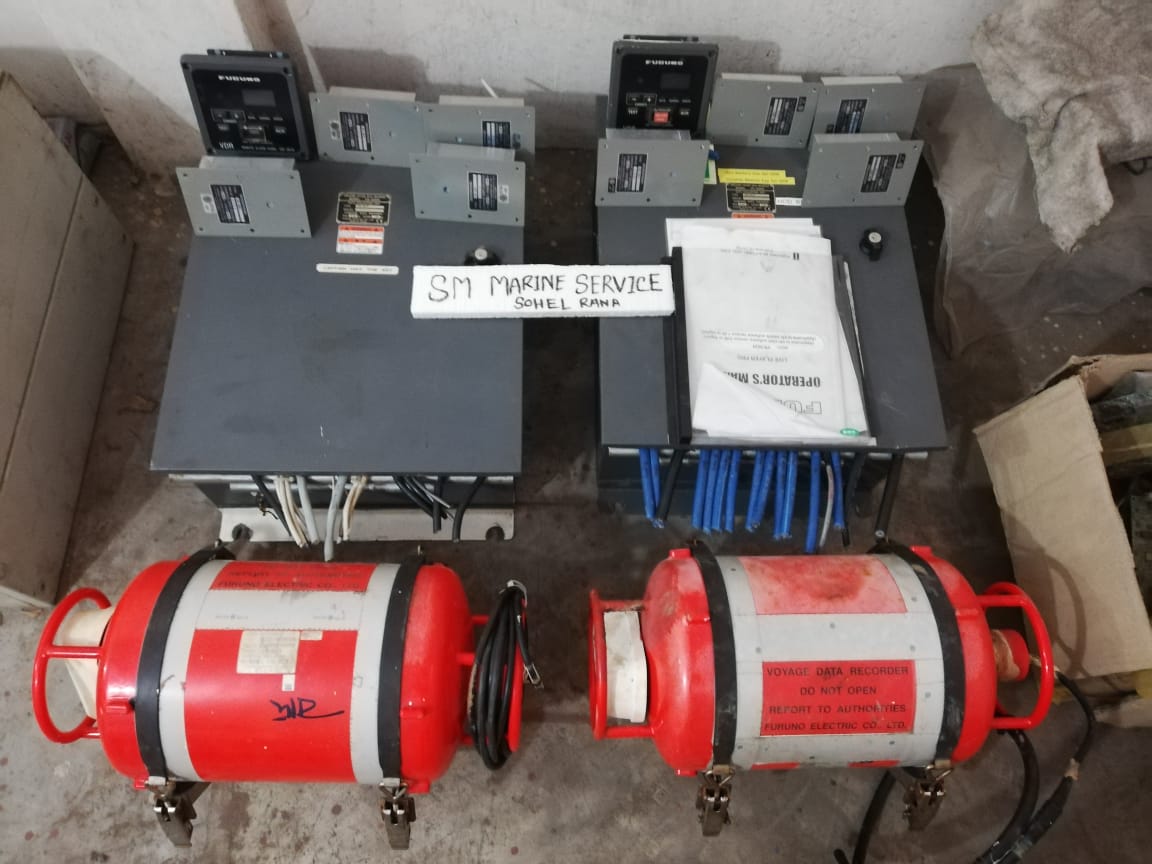
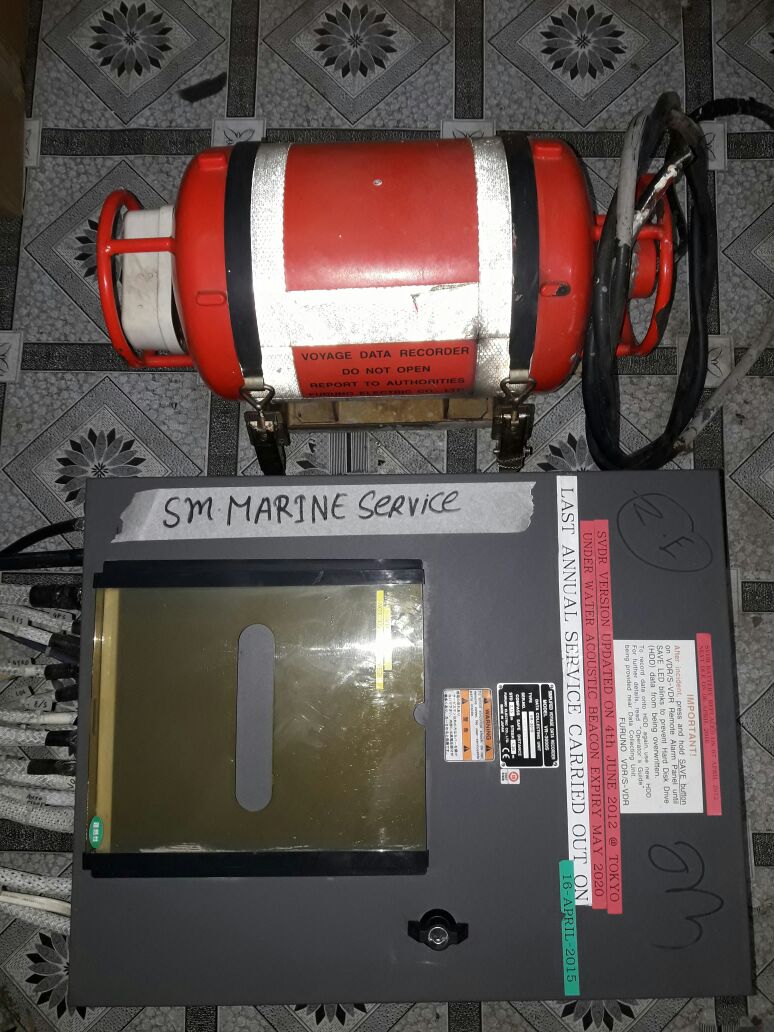
The equipment shown in the supplied photograph is clearly identified on its nameplate as a FURUNO Data Recording Unit Type VR-5020. It is the protected recording capsule used as part of FURUNO's marine Voyage Data Recorder architecture.

The FURUNO VR-5020 Data Recording Unit (DRU) is one of the most critical components of a ship's VDR/S-VDR installation. Its function is to preserve voyage information so that essential data can be recovered following a maritime casualty or other serious incident.
FURUNO documentation shows the VR-5020 connected to the Data Collecting Unit through IEEE 1394 / FireWire cabling. In the VR-3000/VR-3000S system, the DRU forms the protected storage element while a secondary backup storage arrangement allows easier retrieval of recorded information.
The VR-3000S was designed to comply with applicable VDR/S-VDR standards of its generation, including IMO and IEC requirements, and provides UTC time synchronization for recorded data.
A Voyage Data Recorder is often described as the marine equivalent of an aircraft's “black box.”
The ship's VDR collects information from navigation, communication, propulsion and alarm systems. The VR-5020's role is to preserve the required recorded information inside a highly protected capsule.
Typical information handled by the overall VDR installation can include:
FURUNO's official system wiring documentation specifically lists GPS, speed log, heading, echo sounder, autopilot, engine telegraph, steering gear, main-engine remote control, alarms and numerous other shipboard sources connected through the VDR system.
The VR-5020 is designed to retain critical voyage information in the VDR's protected storage module, allowing investigators to retrieve data after an incident.
FURUNO documentation identifies both:
VR-5020-6G – 6 GB version
VR-5020-9G – 9 GB version.
The capsule incorporates a DK-120 underwater acoustic beacon, which assists in locating the recorder following sinking or submersion.
The DRU communicates with the VDR Data Collecting Unit through an IEEE 1394/FireWire connection. FURUNO's VR-3000 installation manual specifies 20 m or 30 m cable options, including armored alternatives.
On the VR-3000/VR-3000S system, the Remote Alarm Panel can be used to initiate preservation of incident data while normal recording continues.
Unlike the Data Collecting Unit and Remote Alarm Panel, which are normally installed in protected areas, FURUNO documentation classifies the DRU for an exposed environment.
FURUNO's official VR-3000/VR-3000S documentation gives valuable information about the components inside the VR-5020 capsule.
The distinctive orange/red enclosure provides the physical protection for the stored voyage data.
The capsule contains a 2.5-inch flash disk used for protected data storage.
FURUNO documentation identifies different flash-storage arrangements for the 6G and 9G versions.
This board interfaces with the internal flash storage.
The connector board forms part of the internal DRU electronics.
This board is another identified internal module within the VR-5020.
The FireWire connection is associated with the repeater/connector arrangement inside the capsule.
The DK-120 is fitted to the capsule so the recorder can be acoustically located underwater after a casualty.
The VR-5020 is intended for commercial vessels equipped with compatible FURUNO VDR or S-VDR systems.
Typical applications include passenger vessels, container ships, bulk carriers, tankers, general cargo ships and other SOLAS-class vessels subject to applicable voyage-data-recording requirements.
FURUNO documentation confirms the VR-5020-6G/9G as the Data Recording Unit in VR-3000/VR-3000S, while official VR-5000 documentation also identifies the VR-5020 series as its DRU.
If the VDR reports loss of communication with the recording capsule, check the IEEE 1394/FireWire cable, connectors, DCU communication interface and DRU electronics.
Cable damage is especially important because the DRU may be installed externally where cabling is exposed to vibration and environmental stress.
If the VDR reports a recording or storage fault, possible causes include:
Because the DRU is a safety-critical protected recorder, internal repairs should be performed only by appropriately qualified personnel.
The underwater beacon has its own battery and requires periodic inspection/replacement according to the beacon manufacturer's approved maintenance interval.
An expired beacon battery may leave the VDR electrically operational while compromising underwater locator capability.
Loose, damaged or corroded connections can interrupt communication between the Data Collecting Unit and DRU.
Inspect cable routing carefully, especially at deck penetrations and areas subject to vibration.
The capsule is engineered for demanding conditions, but normal vessel maintenance should still include visual inspection for:
A DRU-related alarm does not automatically mean that the capsule itself has failed.
Technicians should first identify the exact alarm and then check the recording path systematically:
Sensor/Data Source → DCU → Communication Cable → DRU → Storage
This helps prevent unnecessary replacement of an expensive recording capsule.
The VR-5020 should be treated as safety-critical navigation equipment rather than as a conventional removable hard drive.
Routine inspection should include checking:
The DK-120 acoustic beacon and its battery deserve particular attention during annual VDR inspections. FURUNO's documentation confirms that the DK-120 forms part of the internal/capsule assembly.
Avoid opening or modifying the protective capsule without appropriate authorization and technical procedures. The integrity of recorded evidence and compliance of the VDR installation are important considerations.
Although newer VDR technologies are now available, many vessels continue operating FURUNO VR-3000, VR-3000S and VR-5000 installations.
The VR-5020 therefore remains relevant as a replacement component for existing systems.
Replacing only a defective compatible DRU may also be more practical than immediately replacing the entire VDR installation, provided the vessel's existing equipment remains acceptable under its applicable flag, class and statutory requirements.
FURUNO documentation confirms that the VR-5020-9G remains an identified capsule/accessory for the VR-3000 family.
The VR-5020 is the protected Data Recording Unit (DRU) used in compatible FURUNO Voyage Data Recorder and Simplified Voyage Data Recorder systems.
Yes. It is the protected storage capsule of the VDR/S-VDR system.
Official documentation identifies it with the VR-3000, VR-3000S and VR-5000 series.
They are versions with different flash-storage capacities: approximately 6 GB and 9 GB, respectively.
Yes. FURUNO's documentation identifies a DK-120 Underwater Acoustic Beacon in the assembly.
The documented VR-3000/VR-3000S installation uses IEEE 1394 / FireWire cabling between the Data Collecting Unit and DRU.
Depending on the system configuration, it can collect data such as position, heading, speed, depth, radar, VHF audio, bridge audio, engine telegraph, steering information, alarms and numerous other shipboard signals.
A compatible tested unit may be suitable for an existing system, but the exact model/version, storage configuration, system compatibility, beacon status and applicable VDR regulatory/service requirements should be verified before installation.
The FURUNO VR-5020 Data Recording Unit is a protected VDR/S-VDR recording capsule designed for compatible FURUNO voyage data recorder systems, including the VR-3000, VR-3000S and VR-5000 series. Available in VR-5020-6G and VR-5020-9G versions, the unit incorporates protected flash storage, internal interface boards and a DK-120 underwater acoustic beacon. It is a critical component for preserving ship navigation, communication, alarm and operational data following a maritime casualty.
0
BDT 0
BDT 0
BDT 0
BDT 0
Marine Equipment Supplier